


What is the difference between the first and 2. three generations of semiconductors?
Release time:
2020-06-19
Semiconductor raw materials have gone through three stages of development: the first stage is based on silicon (Si), germanium (Ge) as the first generation of semiconductor raw materials; the second stage is based on gallium arsenide (GaAs), indium phosphide (InP) and other compounds; the third stage is based on gallium nitride (GaN), silicon carbide (SiC), zinc selenide (ZnSe) and other broadband semiconductor raw materials.
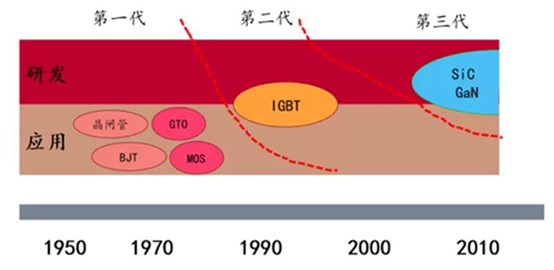
History of Semiconductor Materials and Devices
In the field of materials, the first generation, the second generation, the third generation does not have“The latter generation is better than the previous generation”The statement. Materials such as gallium nitride and silicon carbide are generally called wide band gap semiconductors abroad; gallium nitride, aluminum nitride, indium nitride and their mixed crystal materials become nitride semiconductors, or gallium nitride, gallium arsenide and indium phosphide becomeIII-VGroup semiconductors. The third generation of semiconductor materials adopted in China corresponds to the three industrial revolutions brought about by the large-scale application of semiconductor materials in human history. At present, the third-generation semiconductors are developing at a high speed, and the first and second-generation semiconductors are still used on a large scale in the industry, playing an irreplaceable role in the third-generation semiconductors. What progress does the third generation semiconductor have compared with the first generation and the second generation? What are the technical differences between these three generations of semiconductors? Why is gallium nitride(GaN)and silicon carbide(SiC)Highly sought after in third-generation semiconductors?
01
First Generation Semiconductor Materials
Rise timein the 1950 s;
Representative Materials: Silicon (Si), germanium element (Ge) Semiconductor materials.
historical significance: The first generation of semiconductor materials gave rise to integrated circuits (IC) as the core of the rapid development of microelectronics. Due to the narrow band gap of silicon material, the low electron mobility and breakdown electric field,SiApplications in the field of optoelectronics and high-frequency high-power devices are subject to many limitations. However, the first generation of semiconductors have high technological maturity and cost advantages, and are still widely used in the field of electronic information and new energy and silicon photovoltaic industries.
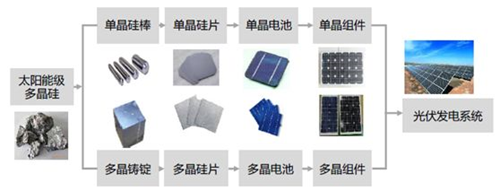
Silicon application industry chain in the field of photovoltaic
02
Second Generation Semiconductor Materials
Rise time:20Since the nineties of the century,With the rapid development of mobile communication, the rise of the information superhighway based on optical fiber communication and the Internet,Gallium arsenide, indium phosphide as the representative of the second generation of semiconductor materials began to emerge.
Representative Materials: The second-generation semiconductor materials are compound semiconductors; such as gallium arsenide (GaAs), indium antimonide (InSb);GaAsAl,GaAsP; and some solid solution semiconductors, suchGe-Si,GaAs-GaPGlass semiconductors (also known as amorphous semiconductors), such as amorphous silicon, glassy oxide semiconductors; organic semiconductors, such as phthalocyanine, copper phthalocyanine, polyacrylonitrile, etc.
Performance characteristicsCompared with the first generation of semiconductors, gallium arsenide has the characteristics of high frequency, radiation resistance and high temperature resistance, so it is widely used in mainstream commercial wireless communication, optical communication and national defense industry.
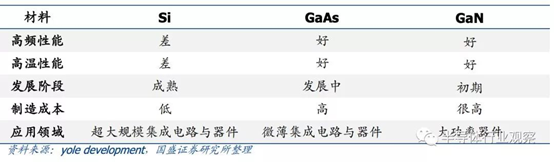
historical significance: The second generation semiconductor materials are mainly used to make high-speed, high-frequency, high-power and light-emitting electronic devices, and are excellent materials for making high-performance microwave, millimeter wave devices and light-emitting devices. Due to the rise of the information superhighway and the Internet, it is also widely used in satellite communications, mobile communications, optical communications andGPSareas such as navigation. For example, compared to the first generation of semiconductors, gallium arsenide (GaAs) can be applied in the field of optoelectronics, especially in infrared lasers and high-brightness red diodes.
From21At the beginning of the 21st century, smart phones, new energy vehicles, robots and other emerging electronic technologies have developed rapidly. At the same time, the global energy and environmental crisis is prominent, and energy utilization tends to be low power consumption and fine management. The traditional first and second generation semiconductor materials have been unable to meet the needs of science and technology due to their own performance limitations, which calls for the emergence of new materials to replace them.
03
third generation semiconductor materials
Time of OriginThe United States was earlier.1993The first gallium nitride materials and devices have been developed in, and the earliest research team in China——Institute of Semiconductors, Chinese Academy of Sciences1995Research in this area was also initiated in2000years made.HEMTStructural materials.
Representative Materials: The third generation of semiconductor materials are mainly silicon carbide (SiC), gallium nitride (GaN), zinc oxide (ZnO), diamond, aluminum nitride (AlN) as the representative of the wide band gap (Eg》2.3eV) Semiconductor materials.
development status: in5GUnder the clear traction of application requirements such as communications, new energy vehicles, and photovoltaic inverters, the head companies in the application field have begun to use third-generation semiconductor technology, which has further boosted industry confidence and firm investment in the third-generation semiconductor technology route.
Performance analysis: Compared with the first and second generation semiconductor materials, the third generation semiconductor materials have a wider band gap(>2.2eV), higher breakdown electric field, higher thermal conductivity, higher electron saturation rate and higher radiation resistance, more suitable for the production of high temperature, high frequency, high power and radiation resistance devices, can be widely used in high voltage, high frequency, high temperature and high reliability and other fields, including radio frequency communication, radar, satellite, power management, automotive electronics, industrial power electronics, etc.
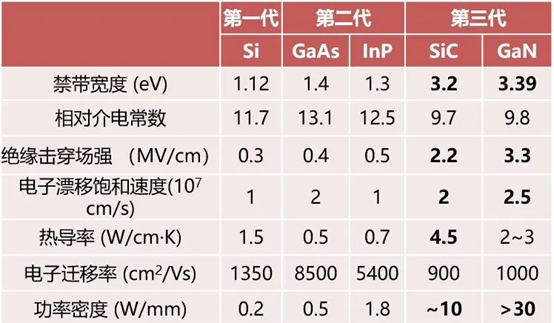
Comparison of Main Performance Parameters of Semiconductor Materials
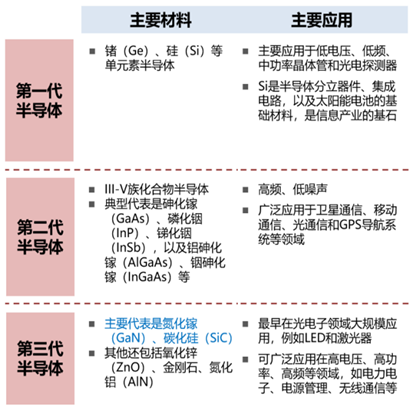
Main Materials and Applications of Semiconductors
In the third generation of semiconductors,SiCwithGaNIn comparison, the former is relativelyGaNThe development is earlier and the technological maturity is higher; one big difference between the two is thermal conductivity, which makes it possible in high-power applications,SiCdominant position; at the same time dueGaNIt has a higher electron mobility and thus can be comparedSiCorSiWith higher switching speed, in high frequency applications,GaNHave advantages.
From the following table commonly used“Superior Value (Figure of Merit, FOM)”It can be clearly seen that,SiCandGaNCompared with the previous two generations of semiconductor materials, the functions and characteristics have been greatly improved.
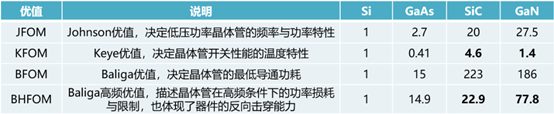
*The above merit value is based onSiMaterial as Unit1, normalized
GaNandSiCEach has its own advantages and disadvantages in material performance, so it has its own emphasis and complementarity in the application field. SuchGaNof high frequencyBaligaThe merit is significantly higherSiC, thereforeGaNadvantages in the field of high-frequency small power, focusing on1000VHereinafter, for example, a communication base station, a millimeter wave, etc.SiCofKeyeThe merit is significantly higherGaN, thereforeSiCThe advantages of high temperature and1200VThe above large power fields include electric power, high-speed rail, electric vehicles, industrial motors, etc. In the low and medium frequency, low and medium power fields,GaNandSiCcan be applied, with the traditionalSiBase device competition.
Third-generation semiconductors-Gallium Nitride(GaN)
GaNThe devices mainly include RF devices, power electronic power devices, and optoelectronic devices.GaNThe commercial applicationLEDlighting and lasers, which are more based onGaNdirect band gap characteristics and spectral characteristics, related industries have developed very mature. RF devices and power devices play aGaNMain application fields of wide band gap semiconductor characteristics.
Application advantages: small size, high frequency and high power, low energy consumption and fast speed;5GCommunication will beGaNKey growth drivers for the RF devices market.
5GThe base station will use multiple-and-receive antenna array solutions,GaNRF devices provide a huge improvement in the power consumption and size of the entire antenna system. In high-power, high-frequency RF applications, higher bandwidth, faster transmission rates, and lower system power consumption,GaNRF power transistor as a new solid-state energy microwave source, replacing the traditional2.45GHzMagnetrons are used in consumer electronics and industrial applications, from microwave ovens to high-power welding machines.
2017The size of the global power semiconductor market in327Billions of dollars, expected2022Year reached426Billions of dollars. Industrial, automotive, wireless communications and consumer electronics are the top four end markets.
Third-generation semiconductors-Silicon Carbide(SiC)
SiCFrom the last century70The research and development began in the s.2001YearSiCSBDCommercial,2010YearSiCMOSFETCommercial.SiCIGBTIt is currently under development.SiCIt can greatly reduce the switching loss in power conversion, so it has better energy conversion efficiency, it is easier to realize the miniaturization of the module, and it is more resistant to high temperature.
SiCThe main application of power devices: Smart grid, transportation, new energy vehicles, photovoltaic, wind power;New energy vehicles areSiCKey Growth Drivers for the Power Devices Market. CurrentlySiCThe application of devices in new energy vehicles is mainly power control units.(PCU)Inverter,Alcatel re-stockingConverter, car charger, etc.
2017Global YearSiCTotal power semiconductor market3.99Billions of dollars. expected2023year,SiCThe total market for power semiconductors will reach16.44Billions of dollars.
04
Summary
Long-term coexistence of first and second generation semiconductor technologiesAt this stage, the first and 2. three generations of semiconductor materials are widely used. Why did the second generation not replace the first generation? Can the third generation of semiconductors fully replace traditional semiconductor materials?
That's becauseSiand compound semiconductors are two complementary materials, and certain performance advantages of the compound compensate forSidisadvantages of the crystal, whileSiThe crystal production process has obvious irreplaceable advantages, and both have certain limitations in the application field. Therefore, in the application of semiconductors, compatible means are often used to make the two compatible, taking their respective advantages, so as to produce products that meet higher requirements, such as high reliability and high speed national defense military products. Therefore, the first and second generations are a long-term common state.
The third generation is expected to replaceThe third generation of wide band gap semiconductor materials can be widely used in various fields, such as consumer electronics, lighting, new energy vehicles, missiles, satellites, etc., and has many excellent properties to break through the development bottleneck of the first and second generation semiconductor materials. Therefore, while being optimistic about the market, with the development of technology, it is expected to replace the first and second generation semiconductor materials in an all-round way.
New infrastructure provides huge development opportunities for domestic semiconductor manufacturers: China's start in the third semiconductor materials is relatively late, and the level of technology is relatively low compared to foreign countries. This is an opportunity to overtake in a corner, but there are still many difficulties and challenges that our country needs to face.
4Month20Day, the National Development and Reform Commission's first official announcement.“New Infrastructure”The scope of the, officially set the tone5GInfrastructure, artificial intelligence, industrial Internet and other seven areas of development direction.“New Infrastructure”As an emerging industry, one end is connected with the ever-upgrading consumer market, and the other end is connected with the rapid development of scientific and technological innovation. It is worth noting that either5G, new energy vehicles or industrial Internet, etc,“New Infrastructure”The construction of various industries is closely related to the development of semiconductor technology. For example: with gallium nitride(GaN)as the core of the RF semiconductor, supporting5GConstruction of base stations and industrial Internet systems; silicon carbide(SiC)andIGBTAs the core of the power semiconductor, supporting new energy vehicles, charging piles, base stations./Construction of data center power supplies, UHV and rail transit systems;AIChip as the coreSOCChips support the construction of data centers and artificial intelligence systems.
It is not difficult to see that gallium nitride(GaN)and silicon carbide(SiC)The third generation of semiconductors is supported“New Infrastructure”The core material. In“New Infrastructure”With the blessing of domestic substitution, domestic semiconductor manufacturers will usher in huge development opportunities.
Related News
Finally, Tian Jinliang said that the company will live up to the expectations of the leaders. In 2023, the company will lay a good foundation, stabilize the industry, and "recruit and retain" professional talents. It will focus on the construction of enterprise research and development centers, the development of professional intelligence, foreign trade exports and other sectors, so as to push the company to become bigger and stronger and realize the cluster development of sensor industry chain in our district.
2023-09-25
On the afternoon of August 22, the Provincial Department of Industry and Information Technology held a conference to learn and convey the spirit of the provincial industrial and information work symposium and the industry association "Gathering the number one project and grasping the three economies" symposium. The purpose of the meeting is to thoroughly implement the spirit of the provincial industrial and information work forum, play the role of bridge and link, and improve the work efficiency of industry associations in the field of industry and information technology in our province.
2023-09-25
Dezhou manufacturing base full chain trial production success
Through debugging, the former Die Bond and Wire Bond equipment have fundamentally corrected the chip corner offset, crack, abnormal glue, gold wire collapse, gold ball offset and other undesirable phenomena. After verification, the chip shear force, gold wire pull, gold ball thrust have reached the standard, the chip yield has improved and remained stable at 99.8, in line with the industry standards.
2023-09-25
Dezhou Huake Production Progress Report
Dezhou Huake TO-92 and 1075B version MSOP8 two sets of calibration production equipment, on December 1, 2022, under the condition of limited epidemic manpower and with the assistance and support of the district government, through the cooperation of test engineer Zhang Chaochao and equipment engineer Jin Chenfei, the two sets of calibration equipment were debugged at the wrong time day and night. On December 9, 2022, through 9 days of unremitting efforts, the problem that the rotation and offset of TO92 new product cannot be confirmed is solved, and the test card version and test fixture are replaced through repeated verification. The calibration yield of MSOP8 was increased from 80% to 97%, which solved the problem of high misjudgment rate in workshop tests, successfully realized the smooth and efficient operation of the two production lines, and reached the targets of 16K output on TO92 and 3K output on MSOP8.
2023-09-25
Lu Energy Technology [2019] No. 22
According to the Provincial Party Committee and the General Office of the Provincial Government "Shandong Provincial Energy Bureau Responsibility Allocation, Internal Institutions and Staffing Regulations" (Lu Ting Zi [2019] No. 36), combined with the Provincial Energy Bureau "2019 Provincial Energy Work Guidance" (Lu Energy Office [2019] No. 15), we are now soliciting a batch of key new technologies, new products and new equipment in the energy field. Relevant matters are notified as follows.
2019-09-22
Contact Us
> Address: F7-2-201-203, innovation works, 2016 Feiyue Avenue, High-tech Zone, Jinan City, Shandong Province
> Marketing Department:+86-531-55770800
> Operator:+86-531-55770700

Sweep, pay attention to us
Copyright:Shandong Huake Semiconductor Research Institute Co., Ltd. Technical Support:300.CN Jinan2 Seo 【Business license】